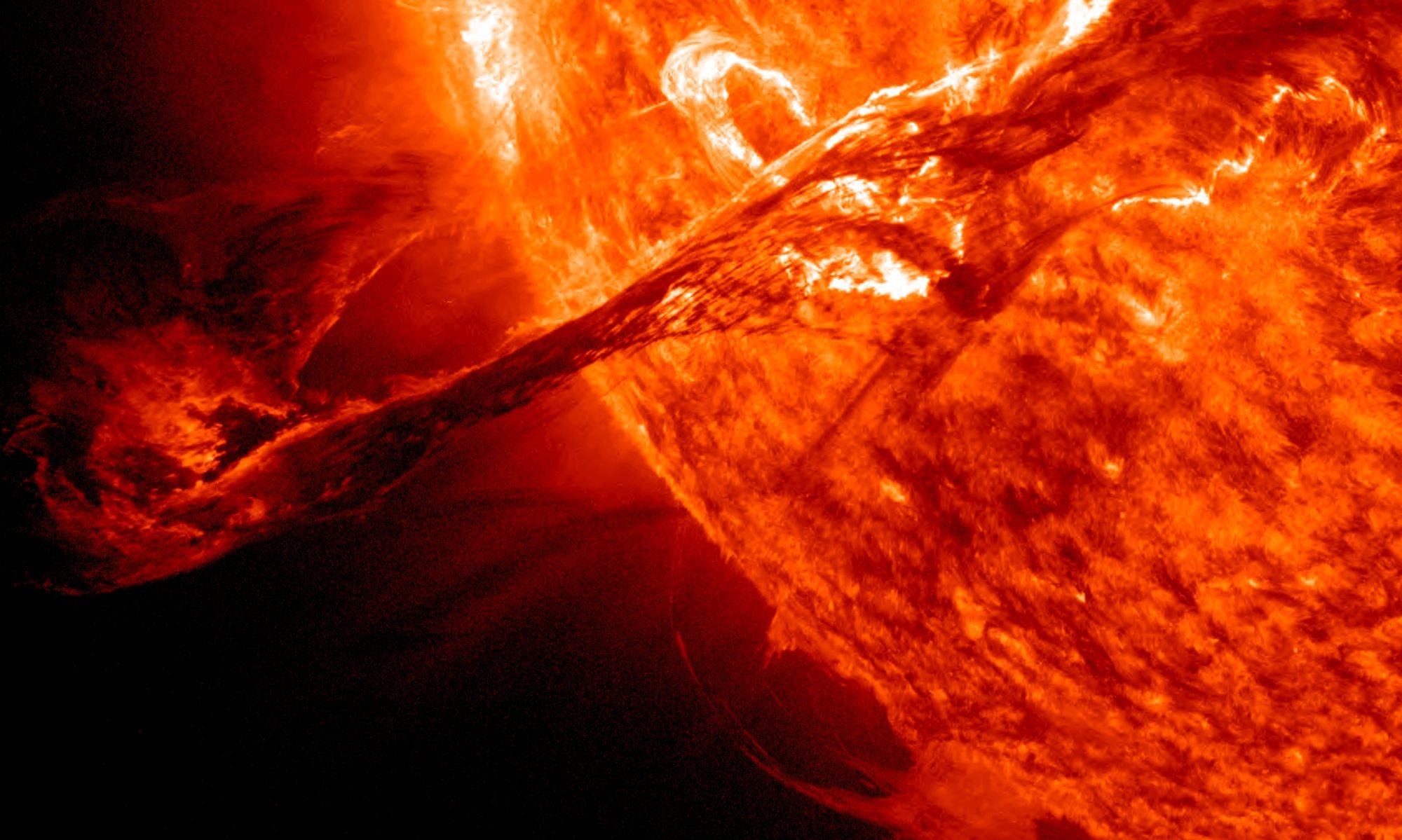
Important!!
Modelling weather for the future months in the US gives this warning of triple arctic jets coming and settling for long time in the US areas from November onwards.
It looks like the modern GSM (2020-2053) is progressing normally as Shindell et al. 2001, Science discovered from the previous GSM, Maunder minimum https://www.giss.nasa.gov/pubs/docs/2001/2001_Shindell_sh05100g.pdf


- Public conference on Precession and Ancient Knowledge, Newport beach, California, US, 25-27 September 2026 – ‘The two-millennial solar orbital motion versus grand solar minimum and their effects on terrestrial environment’ – a public talk by Prof. Zharkova with ppt file attached here


2. South-East Asia is cooling – reported by True man, Linkedin user

Thailand: https://lnkd.in/p/gGzfkcY9
Laos: https://lnkd.in/p/gK8f5ZQh
Vietnam: https://ourworldindata.org/grapher/monthly-average-surface-temperatures-by-year?country=~VNM
Cambodia: https://ourworldindata.org/grapher/monthly-average-surface-temperatures-by-year?country=~KHM
I ssimply couldn’t ggo away youur site before suggeesting thaat I extremely loved the standard
info a perrson provide to your visitors?
Is gonna bbe back regularly to inspect new posts xnxx
I think the admi of this web page iis actually worfking har in support of hiis site,
as here everry data iis quality based material.
xnxx
Dear Valentina
A copy of my recent linked in post
I recently took a forensic deep dive into why the Sporer grand solar minimum is no longer able to be attributed to the occurrence of supernova Vela Jr and take this opportunity to share the incredible but somehow unsurprising outcome
My investigation strongly suggests that the original 1300 AD explosion date was entirely accurate
The entire situation is interpreted by me as a highly coordinated, data-forcing illusion
By excluding the 1300 AD timestamp from modern catalogs, the consensus successfully prevented a domino effect that would have systematically dismantled the historical radiocarbon calendar.
The complete synthesis below demonstrates how every piece of physical data from the fading space signal to the Antarctic ice sheet was systematically re-explained to protect the mainstream climate CO2 alarmist consensus baseline.
I contend that Valentina Zharkova’s double-dynamo wave model is correct. The Sun’s internal magnetic engine operates on highly rigid, stable cycles that do not undergo massive, erratic baseline drops.
Consequently, the massive historical plateaus of radionuclides (Carbon-14 in tree rings and Beryllium-10 in ice cores) traditionally used to define the Spörer Minimum (1450–1550 AD) were not caused by a dropping solar wind Instead, they record the physical arrival of a massive, multi-decade wave of interstellar cosmic rays from the Vela Jr. supernova explosion striking Earth’s upper atmosphere.
Mainstream models assume that the background galactic cosmic ray flux is an unchangeable constant. Because they omitted this point-source supernova radiation wave from their calculations, a severe systematic error was introduced into the radiocarbon calibration matrix shifting the radiocarbon calendar dates by approximately 200 years.
High-resolution AMS tree-ring tracking shows that a weak 11-year solar rhythm was still pulsing under the surface during the Spörer Minimum The Sun’s dynamo never slowed down or faded. The 11-year cycle was simply drowned out and masked in the terrestrial record by the sheer volume of steady, overriding background cosmic rays pouring in from the supernova.
The severe regional cooling and agricultural disruptions observed between 1450 and 1550 are completely stripped of a solar explanation. They are explained 100% by independent, explosive volcanic sulfate forcing specifically the 1452/1453 Kuwae and 1477 Bardarbunga eruptions. These events formed an independent aerosol mirror in the stratosphere that blocked sunlight, completely separate from what the solar dynamo was doing.
The transition from a young supernova model to an ancient, multi-thousand-year object was executed by turning a fading radioactive signature and a line-of-sight alignment into an elegant but flawed consensus shield.
In 1998, NASA’s COMPTEL satellite detected a prominent 1.16 MeV gamma-ray line, proving the active presence of Titanium-44 (⁴⁴Ti) in Vela Jr. Possessing a strict half-life of 58.9 ± 0.3 years, this pure nuclear signature placed the explosion firmly at approximately 1300 AD at a close proximity of 200 parsecs.
Mainstream astronomy used subsequent flat lines on later detector graphs to claim the 1998 discovery was a “spurious fluke”. In reality, because radioactive decay does not pause for telescope funding cycles, 20% to 30% of that Titanium-44 reservoir had physically decayed into stable calcium over the next two decades. The signal simply evaporated, sinking beneath the complex noise floor of the interstellar medium.
To push the remnant out of recent history, Katsuda et al. (2008) measured a slow angular expansion rate along the remnant’s northwestern rim using XMM-Newton data. This calculation relied on a frictionless, uniform expansion model. It ignored the fluid dynamics of a recent shockwave slamming into the dense, pre-existing gas walls left behind by the older foreground Vela XYZ remnant, a collision that causes severe localized deceleration.
The final reclassification relied on using the MUSE instrument on the Very Large Telescope to claim that an infant star, Ve 7-27, was physically embedded within the supernova ejecta. By using the Gaia satellite to measure the star’s distance at 4,600 light-years, the model forced an outward distance revision of the remnant. Because a larger distance requires an expanded physical radius to maintain the same visual size, the expansion equations were successfully manipulated to output an artificial, ancient age of 1,600–3,300 years old, cleanly removing the event from modern human history
In the late 1990s, polar ice cores drilled at Dome C and Accession Island revealed a sharp, narrow nitrate ion (NO₃⁻) spike precisely dated to 1320 ± 20 AD. This spike was completely devoid of volcanic sulfate markers, marking pure nitrogen-based upper-atmosphere ionization caused by the initial wave of gamma radiation from Vela Jr. striking Earth.
To sever this ground-based evidence from the supernova timeline, consensus literature reclassified the spike as localized meteorological noise (post-depositional wind drifting) or an extreme, unprecedented Solar Proton Event (SPE)
However, localized wind cannot create a synchronized chemical spike across geographically separated ice sheets simultaneously, and a solar flare of that magnitude directly contradicts the mainstream narrative of long-term solar stability.
Modern data reconstructions (Hayakawa et al., 2020; Brehm et al., 2021) officially stripped the Dalton Minimum (1790-1830) of its Grand Solar Minimum classification because its sunspots remained symmetric, its 1806 coronal streamers were intact, and its 11-year cycle rhythm was fully active in tree rings. Its cooling was driven entirely by the volcanic aerosol forcing of Mount Tambora (1815).
The consensus isolates and downgrades the Dalton Minimum to remove natural solar variability from the industrial era, protecting modern greenhouse gas warming baselines. Yet, they refuse to apply the same standard to the Spörer Minimum which also contains a persistent 11-year cyclic rhythm under the surface and major volcanic drivers
Because admitting the Spörer’s similarity would expose beyond doubt the existence of an uncalibrated 1300 AD supernova radiation wave that invalidates the CO2 alarmists entire historical radiocarbon calendar.
My regular followers will understand that this successful maintenance of the illusion that the Sporer was a GSM is the only remaining rational obstacle to full acceptance of the current reality of the Modern Grand Solar Minimum as has been revealed in precise mathematical detail by Professor Valentina Zharkova many years ago
A bit of technical detail on T44
Composed of 22 protons and 22 neutrons. It is an “alpha-process” nucleus, possessing an equal number of protons and neutrons
Half life is 58,9 plus or minus 0.3 years
Astrophysical mechanism for formation – Titanium-44 is not produced through steady-state stellar nucleosynthesis or cosmic ray spallation; it is forged exclusively during core-collapse supernovae (Type Ib/Ic and Type II) and rare sub-Chandrasekhar Type Ia supernovae.
It is created in the deepest, innermost layers of the exploding star, immediately adjacent to the forming neutron star or black hole. This zone undergoes explosive silicon burning.
As the supernova shockwave passes through the silicon-burning zone, the temperature spikes dissociating the matter into a plasma of protons, neutrons, and alpha particles. As the blast wave expands, the material cools incredibly rapidly. This rapid expansion is called an “alpha-rich freeze-out.During this freeze-out, alpha particles fuse in a rapid succession of capture reactions
Because Titanium-44 is forged so deep inside the core, its escape depends entirely on the spatial geometry and asymmetry of the explosion. If the blast lacks sufficient energy or asymmetry, the synthesised T44 is pulled back by gravity and swallowed into the resulting black hole or neutron star (fallback). Its presence in a supernova remnant proves that material from the deepest engine of the core was successfully ejected into interstellar space.
Titanium-44 is radioactive and decays via pure electron capture (epsilon) into stable Calcium-44 through a two-step decay chain. This process releases highly specific, discrete gamma-ray lines that act as a strict cosmic clock
Step 1: Titanium-44 to Scandium-44
The nucleus captures an inner-shell orbital electron, converting a proton into a neutron.
This decay populates the unstable daughter nucleus, Scandium-44 primarily into its excited states 67.9 keV and 146 keV energy levels).
As the Scandium nucleus immediately drops to its lowest ground state, it releases two low-energy gamma-ray lines being 67.9keV gamma-ray photon and 78.4 Kev gamma ray photon
Step 2: Scandium-44 to Calcium-44 (The 1.16 MeV Signature)
Half-Life of Intermediate- Sc-44} has a very short half-life of only 3.93 hours.
It decays rapidly into stable Calcium-44 doing so through positron emission (beta+ 94.3% of the time) or further electron capture (5.7%).
As the newly formed Calcium nucleus sheds its remaining excess excitation energy to reach a stable ground state, it releases a highly energetic, prominent gamma-ray line being 1157 Kev (commonly written as 1.16 MeV
Because 94.3% of this step involves positron emission, the escaping positrons immediately collide with surrounding electrons in the interstellar medium, generating a secondary emission line at 511 keV
due to matter-antimatter annihilation.
Observational Use in Modern Astronomy
Because of its unique 58.9-year half-life and highly distinct 1.16MeV line
Titanium-44 serves as an unalterable galactic forensic tool:
If a telescope detects a point-source 1.16 MeV line in space, the source can be mathematically proven to be young (typically less than a few centuries old). If the remnant were ancient, the isotope would have completely decayed away into stable calcium.
Supernova Remnant Examples
This exact signature has been observed and mapped by space telescopes (like COMPTEL, INTEGRAL, and NuSTAR) in two primary historic remnants Cassiopeia A (exploded ~1671 AD) and Vela Jr. (RX J0852.0-4622) (exploded ???????)
This date was 1300 AD but has now been adjusted using expansion equations
and assuming that infant star Ve 7-27 was physically embedded within the supernova Vela Jrs ejecta.
It’s now placed at a more ancient age of 1,600–3,300 years old,
To conceptualise how the distance can be changed in such a way you may recall my recent post regarding the flaring of galactic calibrator 3c138. While 3C138 is seen “in” Taurus it’s actually just viewed thru Taurus and is actually much deeper in space at 7000 billion light years away
Dear Valentina
Summary of my comments posted on the previous LinkedIn posts
The Katsuda et al. (2008) revision relied on observing the slow proper motion of the remnant’s northwestern rim via XMM-Newton to argue that the object must be ancient.
This calculation ignores the fluid dynamics of a supernova blast wave passing through a non-uniform interstellar medium. Vela Jr. is expanding directly into the massive, dense gas clouds left behind by the older foreground Vela remnant.
When a shockwave hits a dense cosmic wall, its physical expansion slows down dramatically due to resistance, even if the explosion happened recently. By treating this localized slowdown as a uniform, frictionless expansion across empty space, consensus models weaponised a standard deceleration anomaly to artificially age the remnant
The final pillar of the mainstream reclassification relies on newer satellites failing to replicate the intense, point-source Titanium-44 line first discovered by COMPTEL in 1998.
The signal didn’t vanish because it was a 1990s instrumental error; it faded because nuclear physics does not pause. With a brief 60-year half-life, the radioactive reservoir forged in 1300 AD was already at the very tail-end of its lifecycle.
By the time subsequent space observations occurred over two decades later, a massive percentage of that remaining material had physically decayed into stable calcium. The signal literally evaporated, dropping below the noise floor of later detectors. Mainstream corrupted astronomy used this inevitable, predictable nuclear decay as a convenient excuse to declare the original, highly dangerous 1300 AD data point a “spurious fluke.”
The core of this entire debate relies on the 1.16 MeV gamma-ray line emission
We must very closely examine the results from the specific follow-up instruments that targeted this line to see which of the conflicting decay arguments holds the upper hand:
BeppoSAX (X-
ray): Shortly after the COMPTEL discovery, the BeppoSAX satellite detected hard X-ray line emissions consistent with Sc 44 the immediate daughter product of T44 at the rim of Vela Jr.
INTEGRAL (SPI/IBIS): The SPI instrument on the INTEGRAL satellite, designed with significantly better spectral resolution than COMPTEL, spent years accumulating data on the Galactic core and remnants. When teams analyzed the INTEGRAL data, the detection of the 1.16 MeV line from Vela Jr. remained highly controversial with some papers claimed a marginal detection with a lower flux than COMPTEL, while others argued it was statistically indistinguishable from background noise.
The data shows that this isn’t just a simple “null result” it is an ongoing battle over signal-to-noise ratios at the ragged edge of gamma-ray astronomy’s current capabilities.